
View: Bearish
Target Price: $65-67/bbl
- Key Drivers:
- Technicals show further weakness is the path of least resistance
- Lack of confident fund risk deployment
- Risk-off week in the news
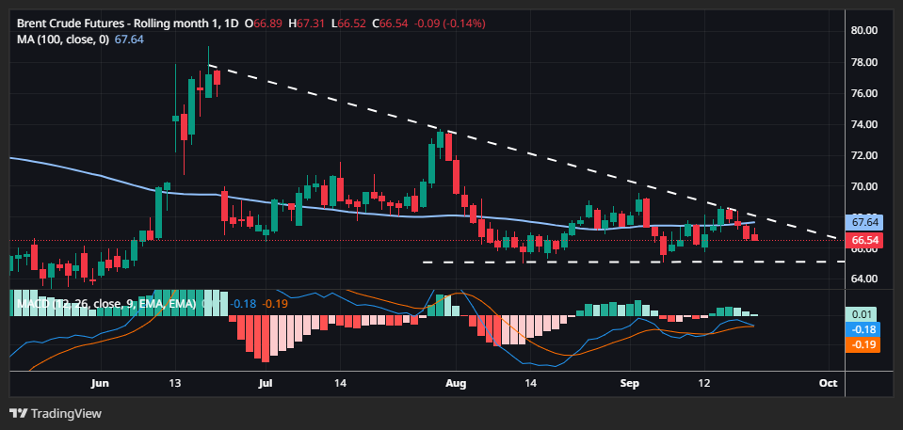
We expect continued weakness to be the path of least resistance in the prompt Brent contract. However, we expect a significant breakout soon, as pointed to by the descending triangle pattern and dropping volatility.
The technical analysis of M1 Brent futures shows a descending triangle pattern, indicating a broader bearish trend (white dashed line). The contract must pass through the previously strong resistance level of the 100-day moving average (blue line) to see any significant improvement. The Average True Range (ATR) has fallen to its lowest level since Q2 2024, highlighting the current low-volatility environment. Therefore, with volatility low and a lack of strong momentum in either direction, we may see the contract continue to trade within the bounds of the triangle ahead of a significant breakout, often preceded by extremely low volatility. It seems the path downwards has the least resistance.
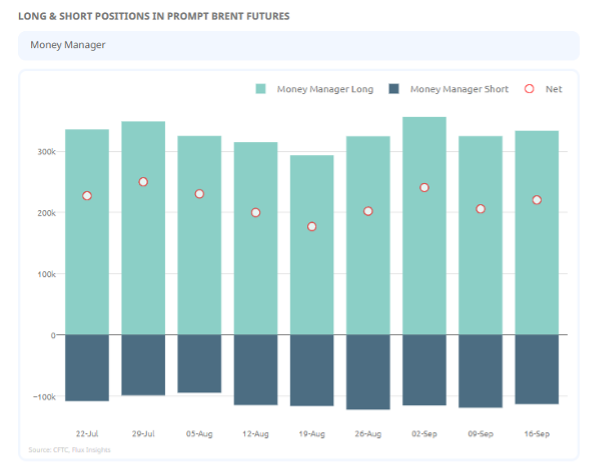
Looking at the COT data for Brent futures, net positioning is up in the week ending 16 Sep but failed to recover from the drop over the previous week. Although it was an unexceptional week in money manager positioning, the total OI in Brent futures sits at 2,974mb compared to a Sep 2020 – Sep 2024 average of 2,216mb and Sep 2020-24 max of 2,725mb. This high OI adds to the risk of a significant breakout mentioned above.
There isn’t much of a clear market narrative otherwise. The US-India deal is moving forward only slowly, and fresh hurdles are emerging after the US introduced a $100,000 fee on H-1B visas for skilled foreign workers. The move has drawn sharp criticism from India, with officials warning it could have “humanitarian consequences.”. In the US, the Senate rejected the latest spending bill, pushing the government closer to a shutdown. This could pressure the USD, but correlations between the USD and oil, negative or otherwise, have been inconsistent. Therefore, the impact of this may be insignificant, and we may continue to see a risk-off market.