Morning Macro 16th September
The US is heading for another monumental TACO buffet with China, as Trump prepares to speak with President Xi on Friday. So far, the discussions have been about TikTok. While Bessent said the US doesn’t plan to impose any tariffs or sanctions on China unless the EU does too. Bessent also added that the next meeting could result in another 90-day tariff truce – ahead of the November 10 deadline.
As the Fed is meeting today to announce its interest rate decision on Wednesday evening, the DC Circuit rejected President Trump’s bid to fire Fed Governor Cook, allowing her to participate in this week’s Fed interest rate decision. In addition, the Senate confirmed White House Council of Economic Advisers Chair Stephen Miran to join the Federal Reserve Board of Governors.
Foreign investors are pouring into US stocks and bonds – albeit at a reduced pace – but they are dumping dollar risk at record speed, Deutsche Bank says. The dollar hedging activity has risen to record levels as investors are reluctant to be exposed to USD fluctuations, even as foreign holdings of US stocks and bonds rose to a record of $33.6 trillion in June, according to the Treasury Department.
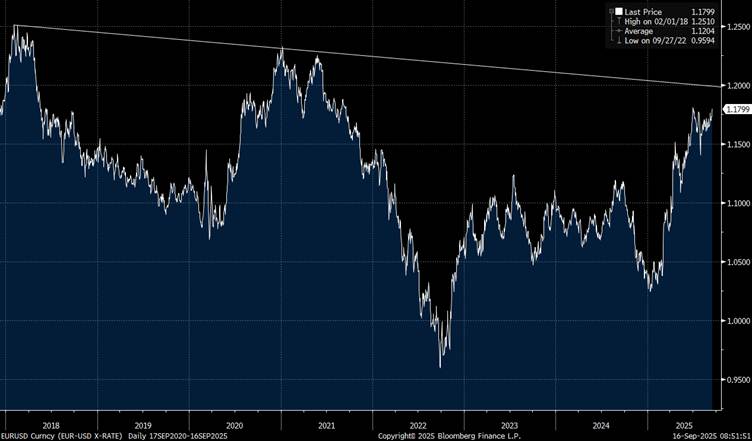
The reduced appetite for dollar holdings, following markets’ expectations of two – with even three in play – quarter-point cuts, could provide further support for the EUR/USD if it tests the break line (Chart 1, Bloomberg).
Meanwhile, passenger vehicle sales in India slipped 9% y/y in August to 280,839 units, snapping July’s modest growth, SIAM data showed. While on a m/m basis, sales fell 6.8% in August after a sharp 9.2% rise in July.
And in the UK, regular pay growth slowed to 4.8% y/y in the three months to July 2025, the weakest since May 2022, with both public and private sectors easing. Real wages still rose 0.7%, led by strong gains in retail, hospitality, and services.
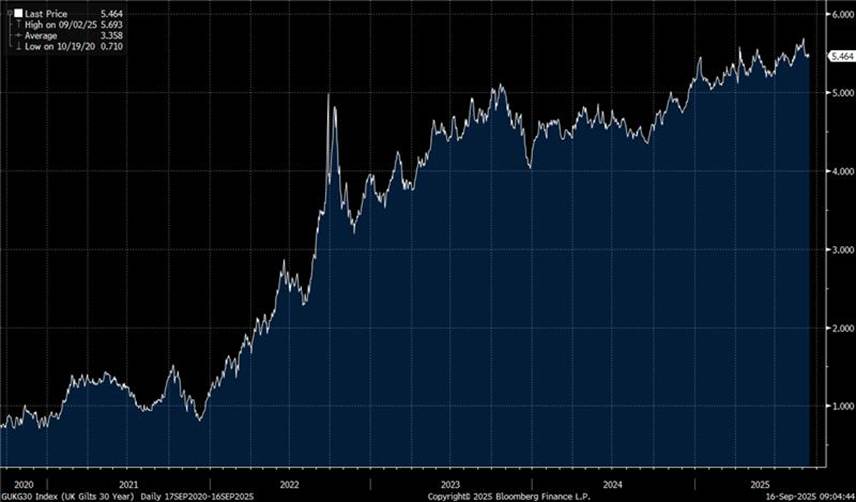
The Bank of England is set to slow its quantitative tightening, trimming gilt sales from £100bn to below £72 billion annually, while keeping rates steady at 4%. The move reflects bond market volatility and rising borrowing costs, with the BoE noting QT’s impact on financing conditions remains modest. The 30-year gilts are trading near 5.5% – the highest among G7 countries (Chart 2, Bloomberg). The UK is in need of more money, but the fiscal concerns are costing even more. The recently issued 10-year gilt showed that an additional 8.25bps on the yield resulted in a £100 million loss of additional funds!
Data today – EA Industrial Production, German Economic Sentiment and Current Conditions, Canadian Inflation rate, US retail sales, import and export prices, manufacturing and industrial production